
The Pause Before the Storm
On December 11th, I published OpenAI’s Counterpunch: Inside Sam Altman’s Code Red. The core argument was straightforward: Gemini’s architectural leap and Claude’s discipline had exposed real cracks in ChatGPT’s reliability.
I argued that OpenAI knew it. "Garlic" wasn’t a product experiment—it was a response. A necessary one.
Then, I did exactly what you’d expect a Naval Academy graduate to do. I unplugged the Mac, shut down the AI noise, and headed to Baltimore to gather with friends and family for America’s game: Army–Navy.
It was a complete physical disconnect. Long delays, extra security, President Trump in attendance, and 70,000+ fans packed into a sold-out M&T Bank Stadium. It was one of the best rivalries in college football—a hard-fought game with Navy barely edging it out, 17–16.
I digress, but this context matters. Because while I was offline watching a traditional ground war, a digital air war was breaking out.
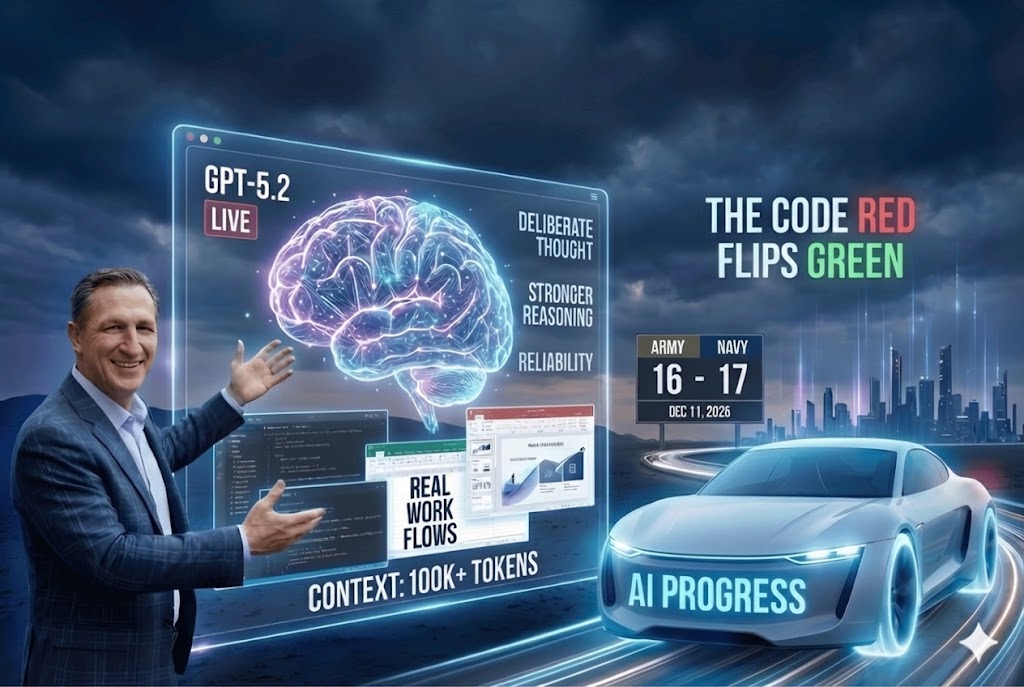
The Code Red Flips Green
When I plugged back in? Boom. Bam. Mic drop. Fire. All at once. Even the Gen-Z crowd doesn’t have a clean word for what this felt like yet. My phone exploded—texts, emails, DMs, Signal, and group chats lighting up.
ChatGPT 5.2 was live. Not quietly. Not eventually. Everywhere. All at once. Sam Altman’s "Code Red" had flipped fully green. Suddenly, the question wasn’t whether OpenAI had heard the warning shot I described in Part I. It was how they chose to respond.
In Plain English: What is ChatGPT 5.2?
Let’s strip this down and talk about what 5.2 actually represents—without the launch-post gloss or benchmark theater.
Rolled out on December 11, 2025, across all paid tiers (Plus, Pro, Business, and Enterprise), this release isn’t about flash. It’s about control.
At a practical level, 5.2 focuses on:
• Deliberate Thought: Includes a "Thinking" mode designed for deeper reasoning over speed.
• Stronger Reasoning: Better performance across complex, multi-step tasks.
• Reliability: Fewer hallucinations, especially in professional workflows.
• Real Work: Better handling of spreadsheets, presentations, coding, and long documents.
• Context: Major gains in long-context performance, stretching into hundreds of thousands of tokens.
• Abstract Power: A significant jump in abstract reasoning benchmarks (like ARC-style tests) that measure generalization rather than memorization.
OpenAI has stated—carefully—that the "Thinking" variant beats or ties human experts across many professional occupations. Whether you take that claim at face value or not, the direction is unmistakable.
The Gym Metaphor: Anyone who’s ever worked with a good personal trainer knows this: it’s not about adding more weight—it’s about fixing your posture. GPT-5.2 didn’t bulk up. It corrected its posture. And suddenly, it holds up under real work.
Confirmation, Not Contradiction
At first glance, GPT-5.2 looked like a narrative reversal of my first article. OpenAI drops a stronger model; headlines swing back; the hype wheel spins again.
But if you actually read Counterpunch, this was always the expected outcome.
• Claude didn’t win by being louder—it won by being disciplined.
• Gemini didn’t win by being bigger—it won by being coordinated.
• Operators didn’t complain publicly—they quietly moved their real workflows.
OpenAI felt that pressure structurally. You can see that pressure reflected throughout 5.2 in its internal coordination, better handling of ambiguity, and reasoning that doesn’t collapse under load.
"Garlic" wasn’t a panic response. GPT-5.2 wasn’t a victory lap. They’re part of the same pivot—away from brute force and toward architected intelligence.
The Real Closing Bell of 2025
Here’s the truth most launch posts won’t say: 2025 wasn’t the year AI got bigger. It was the year it stopped falling apart.
It wasn't a magical breakthrough, but a tightening of fundamentals. Reasoning improved, hallucinations dropped, and for coders specifically, workflows stopped wobbling.
The Generative AI wars were raging in 2025: Gemini forced the architectural rethink while Claude raised the reliability standard. Sam Altman and his team responded with GPT-5.2, proving OpenAI heard the warning shot.
That’s not hype. That’s generative AI maturing. And there’s no turning back. As my friend “Iron Mike” Steadman likes to say: “It’s a great day to be alive.”


