

We just spent the weekend surrounded by the timeless hallmarks of an American summer—the smoke of backyard BBQs, local parades with neighborhood firetrucks, and fireworks bursting under the stars. But as the smoke clears from our nation’s historic 250th birthday, the deeper national conversation surrounding this monumental milestone has been deeply revealing. On one side, we are treated to triumphant corporate platitudes celebrating American innovation, market dominance, and the relentless march of technological progress. On the other, we are subjected to a relentless torrent of cultural anxiety, partisan bile, and cynical hand-wringing over the depth of our political polarization.
If you judge the country solely by the headlines-which I will not refer to as "Fake News" because many Americans feel this way-America appears to be a nation adrift, fractured along geographic, ideological, and socioeconomic fault lines. Take, for example, The New York Times on July 3, 2026, where acclaimed journalist and senior critic-at-large Robin Givhan penned a guest op-ed flatly titled, "Trump Ruined the Fourth of July for Me." Her piece perfectly embodies this mainstream anxiety, exploring how the political polarization surrounding our America 250 milestone supposedly broke the traditional, communal spirit of Independence Day.
Driven by these exact types of headlines, we are told by a chorus of pundits that our divisions are unprecedented, that our civic fabric is tearing irreparably at the seams, and that the very future of the American Experiment hangs by a fragile thread.
Look no further than the global spectacle playing out across our major cities right now to see the power of this false narrative. With millions of global visitors descending on our cities for the 2026 World Cup, international headlines are striking an unexpected tone: utter astonishment.
Traveling fans came to our shores expecting to step into the volatile, hyper-fractured, hostile dystopia they see broadcast on their nightly news feeds. Instead, the international press is scratching its head, marveling at the overwhelming kindness, warmth, and everyday hospitality of the American people. The world is shocked by our baseline decency simply because they, too, have been conditioned to view our country through the warped lens of our political theater.
But this entire doom-and-gloom narrative is built on a fundamental misunderstanding of what America actually is.
We have become a society dangerously obsessed with the ephemeral. We measure the health of our republic by the daily outrages of the digital town square, the latest cable news chyrons, the shifting tides of cultural trends, and the temporary occupants of the White House. We treat America as if it were a collective mood ring, fluctuating wildly based on whatever political faction happens to hold federal power at any given moment.
This is a profound error. Look at how easily our collective attention is hijacked: even as our republic crossed a monumental 250-year milestone, the media headlines were utterly consumed by the pop-culture spectacle of Taylor Swift’s wedding at Madison Square Garden on July 3rd.
But America is not a cultural vibe.
It is not defined by celebrity marriages, billionaire fortunes, or temporary politicians. America is a radical, enduring, and meticulously engineered philosophical framework. Its true soul is not found in our fleeting media obsessions or a shifting national mood but is anchored firmly in the bedrock of the two documents that established it: the Declaration of Independence and the United States Constitution.
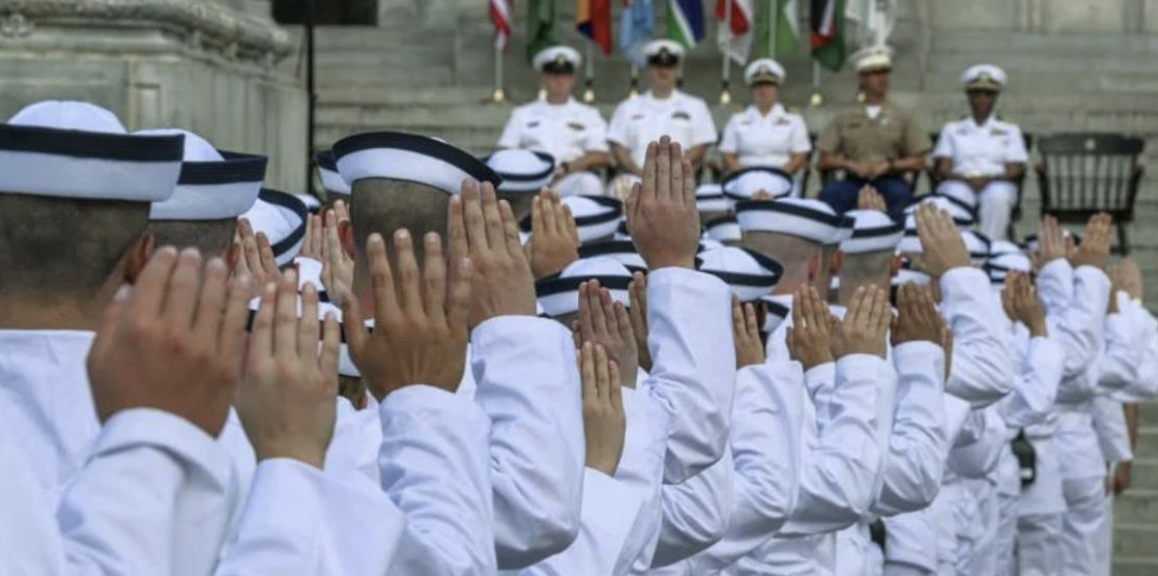
As a graduate of the United States Naval Academy and a former naval officer, this distinction is not a matter of abstract academic debate for me. It is a visceral, foundational reality.
Exactly forty years ago, on July 7, 1986, I stood in Tecumseh Court outside Bancroft Hall at the Naval Academy. It was Induction Day. I raised my right hand – alongside my 1,589 classmates - and took a solemn oath. At graduation, upon receiving our commissions as officers in the U.S Navy or Marine Corps, we took that same oath again! It is a rite of passage shared by every single man and woman who enters the armed forces of the United States.
But if you look closely at the text of that oath, you will find something entirely unique in the history of global warfare:
“I do solemnly swear that I will support and defend the Constitution of the United States against all enemies, foreign and domestic; that I will bear true faith and allegiance to the same…”
Notice the glaring omissions from those words. I did not swear allegiance to a king, a queen, or a supreme military dictator. I did not swear allegiance to a political party, a specific administration, or a charismatic political figure. I did not even swear allegiance to a geographic piece of land or an ancestral tribal identity.
I swore a sacred, binding oath to support and defend not a mortal ruler, but an immortal piece of parchment—or more accurately, the radical framework of liberty etched upon it.
When you raise your right hand for the right reasons, that commitment is entirely irrespective of who happens to sit in political office. As a citizen, and certainly as a military officer, you may privately agree or fundamentally disagree with the President, the Congress, the Senate, or any individual politician. But your allegiance is structurally decoupled from them. You are not pledging your loyalty to a person or a party.
This distinction carries an immense, life-or-death gravity. As a military person, you can be ordered into harm’s way. You can be deployed into a grinding military conflict, an ambiguous engagement, or an outright war that you may personally, privately disagree with. But when you are standing watch on a ship in the middle of a dark ocean, you are not fighting for the specific political agenda of the commander-in-chief who signed the deployment order. You are fighting for the constitutional framework that allows a civilian government to exist, to make those choices, and to govern a free people. You are guarding the system itself.
The legendary Mark Twain once captured this vital boundary perfectly:
“Patriotism is supporting your country all of the time, and your government when it deserves it.”
Centuries earlier, Thomas Paine warned us of the exact same trap, writing that “the duty of a patriot is to protect his country from its government.” Just this past Independence Day weekend, New York Harbor hosted Sail 250, the largest international naval review in our nation’s history, coupled with the 7th International Fleet Review. As those gray hulls and historic tall ships lined the Hudson, they represented more than just raw military deterrence; they represented the defense of an international order built on the very rule of law our Constitution guarantees.
When we deployed, when we stood the watch in the blind darkness of the ocean, and when we watched our brothers and sisters sacrifice their youth and their lives, we did it to protect that framework. We did it so that 342 million Americans back home could enjoy the messy, chaotic, beautiful privilege of self-governance. We executed orders through a chain of command that ultimately leads to the Commander-in-Chief, but our allegiance was never to the person sitting in the chair—it was to the constitutional office they temporarily occupy.
When citizens throw up their hands in despair and claim they are “losing faith in America” because their preferred political party lost an election, they are committing a fundamental category error. They have confused the temporary actors on the stage with the design of the theater itself.
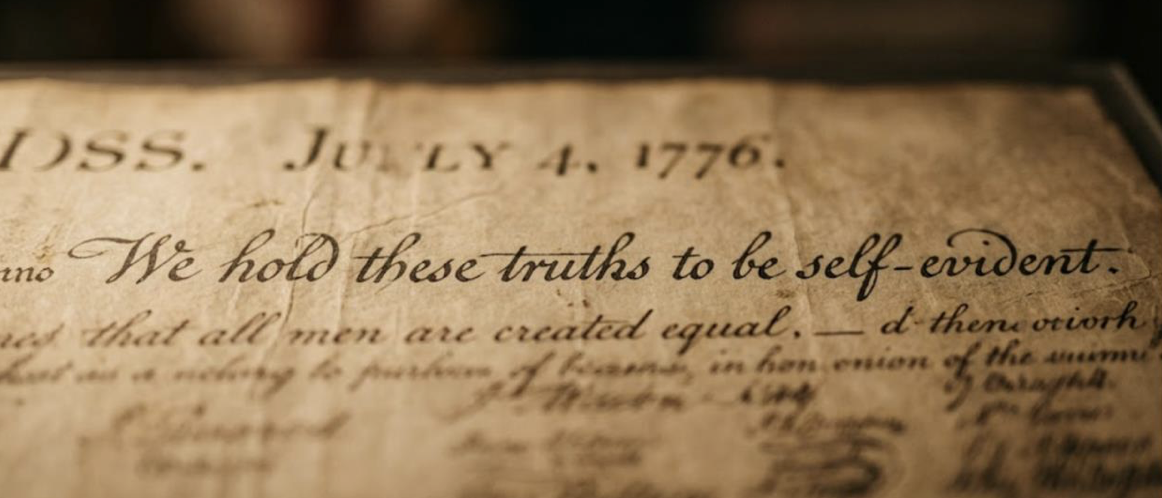
To understand the structural integrity of this theater, we must return to the spark that ignited the flame in 1776. The spiritual DNA of our nation is captured entirely within what biographer Walter Isaacson rightfully calls the greatest sentence ever crafted by human hand.
When Thomas Jefferson sat down in a humid boarding house in Philadelphia to draft the Declaration of Independence, he was tasked with justifying a treasonous rebellion against the most powerful empire on Earth. But he didn’t just write a list of economic grievances about taxes, shipping lanes, and trade. Instead, with the brilliant editorial polishing of Benjamin Franklin and John Adams, he penned a universal manifesto for human dignity.
The second sentence of that Declaration remains the most revolutionary statement in human history:
“We hold these truths to be self-evident, that all men are created equal, that they are endowed by their Creator with certain unalienable Rights, that among these are Life, Liberty and the pursuit of Happiness.”
Consider the sheer audacity of those 35 words in the context of the 18th century. For millennia, human civilization was defined by strict hierarchy. It was taken for granted across the globe that some individuals were born to be kings, emperors, and aristocrats, while the vast majority were born to be subjects, peasants, and serfs. Rights were viewed as privileges handed down by the grace of a monarch or the blade of a conqueror.
Jefferson, Franklin, and Adams turned that entire paradigm upside down.
The drafting process itself reveals the core genius of the American identity. In Jefferson’s original draft, he wrote that these truths were “sacred and undeniable.” It was Benjamin Franklin—the old printer, scientist, and pragmatic philosopher of the Enlightenment—who slashed through those words with his heavy ink strokes, replacing them with “self-evident.”
That single edit shifted the foundation of the American Experiment from a purely sectarian dogma to a premise grounded in human reason and natural law. By declaring these truths to be “self-evident,” the founders bypassed the need for royal decree, papal bull, or historical precedent. They asserted that human equality and individual liberty are baked directly into the fabric of nature itself.
Your rights do not come from the government. They do not come from a president, a parliament, or a majority vote. They are “unalienable” because they are granted by a power higher than any human institution—endowed to every individual by virtue of their humanity.
The sentence defines the ultimate purpose of human society. Government is not the master; it is the servant. As the lines immediately following that great sentence declare, governments are instituted among men solely to secure these rights, deriving their just powers strictly from the consent of the governed. This is the common ground that defines us as Americans. We are not bound together by a shared bloodline or ancient soil; we are bound together by a shared dedication to this single, world-changing proposition.
If the Declaration of Independence gave the American Experiment its soul, it was the United States Constitution that gave it its muscle, bone, and sinew.
A beautiful sentiment is completely worthless if it cannot survive the brutal realities of human nature. The Founding Fathers were not naive utopians. They were deeply read students of history, law, and human failure. They understood that human beings are fundamentally flawed, prone to selfishness, easily corrupted by power, and naturally driven to form tribal factions. They knew that a democracy based on pure, unchecked majoritarian rule would inevitably degenerate into mob rule—the “tyranny of the majority.”
Therefore, in 1787, they gathered again in Philadelphia to engineer a brilliant legal machine designed to save humanity from its own worst impulses.
The U.S. Constitution is a masterpiece of political engineering. It does not operate on the assumption that our leaders will always be wise, virtuous, or benevolent. On the contrary, it is explicitly built for a world where leaders are short-sighted, ambitious, and power-hungry.
Through the elegant separation of powers, the establishment of a bicameral legislature, the creation of an independent judiciary, and the preservation of state sovereignty through federalism, the Constitution ensures that power is constantly fractured and pitted against itself.
As James Madison famously wrote in Federalist No. 51:
“Ambition must be made to counteract ambition… It may be a reflection on human nature, that such devices should be necessary to control the abuses of government. But what is government itself, but the greatest of all reflections on human nature? If angels were to govern men, neither external nor internal controls on government would be necessary.”
This deliberate institutional friction is precisely why our government often feels slow, frustrating, and gridlocked.
It was designed to be that way.
The founders intentionally threw sand in the gears of federal power to prevent any single faction, president, or populist movement from overriding the unalienable rights of the individual. In Federalist No. 10, Madison specifically addressed the danger of “factions”—what we call political parties and polarization today—and explained how a constitutional republic, unlike a pure democracy, is uniquely engineered to break and control the violence of those factions, preventing a passionate majority from trampling the minority.
We do not have to look back to 1787 to see this machine in motion; we only have to look at the Supreme Court’s docket from last week. In a pair of monumental, ideologically complex rulings—Trump v. Slaughter and Trump v. Cook—the Court simultaneously expanded executive oversight of the federal bureaucracy while flatly checking executive authority over the Federal Reserve. In a single afternoon, the framework proved it is neither a rubber stamp for the White House nor a tool for partisan obstruction. It is a scale dynamically balancing power, exactly as intended.
Lest we think this intense partisan fury is a broken feature unique to the 21st century, history provides a stark reality check. Consider George Washington, the beloved father of our country. He left office under a massive swath of unpopularity, bitterly condemned as a sellout to the British simply for signing the infamous Jay Treaty. The public and political fury was so intense that combat veterans actually took to the streets screaming, “A speedy death to General Washington!”
If the constitutional framework could survive its original citizens shouting for the death of the ultimate revolutionary hero, it can easily survive our current pendulum swings. The system isn’t broken; it is working exactly as intended. The pendulum swings, administrations change, and political parties rise and fall—but the structural integrity of the constitutional framework remains completely unshaken.
At Tecumseh Court, my Naval Academy classmates and I raised our right hands and swore an oath to the Constitution. At times, various Presidents ordered us into harm’s way. Politicians declared wars. We may have privately agreed with them – or perhaps privately disagreed with them. No matter - they did not own our allegiance. The Constitution defined us.
The real crisis facing America at our 250-year mark is not political polarization. Our real crisis is a profound, systemic amnesia. We have forgotten what our forefathers actually signed. We have stopped teaching, studying, and respecting the constitutional principles that guarantee our freedom.
We have allowed a hyper-individualistic culture to shift our focus from the collective “WE” of the preamble—We the People of the United States, in Order to form a more perfect Union—to an obsessive focus on the immediate desires of the “ME”. We see this amnesia manifest when people demand that we dismantle constitutional norms simply because those norms produce a political outcome they dislike. We see it when factions try to suppress free speech because they find certain ideas offensive, or when executives attempt to bypass the legislative branch through unilateral decrees.
Our amnesia causes us to flatten a massive continent into a two-dimensional shouting match, completely ignoring the grand, quiet reality of the geographic “WE” to which we belong. Look no further than the official kickoff to this week’s festivities, where the Times Square ball dropped eight separate times over twenty-four hours, sequentially counting down the new century for Americans stretching across every time zone and territory, from the Chamorro time zone of Guam all the way to American Samoa. The framework of our republic was explicitly engineered to hold all of us—spanning vast oceans, diverse cultures, and disparate time zones—under one roof.

Yet, we continue to reduce our national identity to petty partisan bickering. Look at the modern cultural battlefield surrounding Lee Greenwood’s anthem, “God Bless the U.S.A.” Today, cynics routinely roll their eyes at the song because it has become a weaponized staple at modern political campaign rallies. But our systemic amnesia blinds us to its actual origin. The song wasn’t written to endorse a politician, a campaign, or a party; it was penned over four decades ago because Greenwood was deeply moved by a profound international tragedy.
In 1983, Korean Air Lines Flight 007 was shot down by the Soviet Union under the paranoid accusation that it was on a spy mission. All 269 innocent civilians onboard were killed, including 62 Americans. In the vitriolic aftermath of that Cold War atrocity, the song was born out of a determination to unite a grieving country and capture the pride of living in a nation defined by liberty, rather than totalitarian tyranny.
When we lose our historical literacy, we flatten everything into cheap, team-sport politics. When we treat the Constitution as an obstacle to be bypassed rather than the supreme law of the land to be preserved, we play a dangerous game. We chip away at the very foundation that keeps the roof over our heads.
As we look forward to the next 250 years, the prescription for our national anxiety is not to hope for a sudden wave of cultural harmony or a magical political consensus. We are a massive nation of 342 million diverse people, differing perspectives, and competing interests. We are never going to agree on everything, nor should we.
The prescription is a relentless, unapologetic return to constitutional literacy.
We must remember that the beauty of the American Experiment is that it provides a sacred arena where free people can passionately disagree, fiercely debate, and peacefully vote without resorting to political violence or totalitarian control. The blueprint allows us to wrestle honestly with our nation’s flaws, to chip away at our historical prejudices, and to constantly strive toward that “more perfect union”—all while remaining securely anchored to the same legal bedrock.
I fought for that blueprint. My brothers and sisters in arms deployed across the globe to defend that arena. We didn’t do it for a political party, and we didn’t do it to protect a specific cultural ideology. We did it so that the immortal words of the Declaration of Independence would remain a living truth, and so that the Constitution would continue to stand as an unbreakable shield against tyranny.
Tonight, the United States steps onto the world stage against Belgium in Seattle with the eyes of our entire nation and the world watching a country that remains a timeless beacon of light, hope, and freedom. As the celebratory smoke clears from our historic 250th milestone and those stadium lights tonight eventually dim, the radical, enduring framework of our republic remains completely unshaken. Long after today’s politicians have changed and faded from the headlines, that immortal piece of parchment—our United States Constitution—continues to stand its quiet watch over our land. Let us look past the daily friction, remember the collective “WE,” and stand firmly by the supreme law of the land.
May God Bless America forever!


