
Most CEOs can tell you how their AI feels. Almost none can show what it earned. That gap is where operating leverage goes to die.
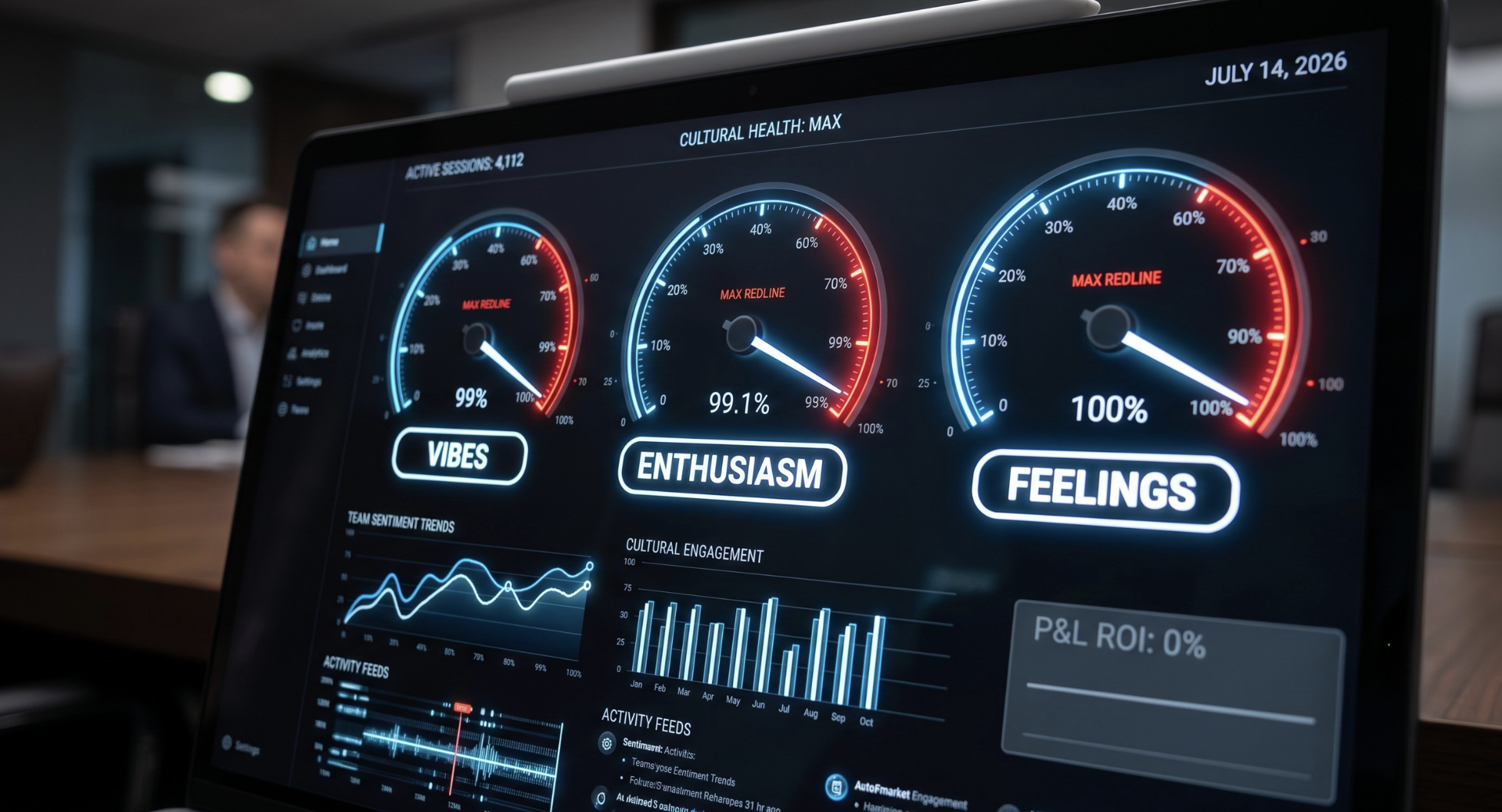
Imagine looking at a corporate performance dashboard where the primary dials aren’t revenue, pipeline, or margin, but instead read: VIBES, ENTHUSIASM, and FEELINGS. Imagine those needles are pinned completely to the redline, while the tiny digital readout in the corner labeled P&L ROI sits aggressively at zero percent.
As ridiculous as that looks, it is exactly how most mid-market and enterprise companies are managing their artificial intelligence spend right now.
Ask a GTM leader what their AI stack returned last quarter and you get an adjective, not a financial figure. It has been “helpful.” The team “loves it.” Adoption is “way up.”
None of that survives a board meeting—and it certainly doesn’t survive a congressional hearing. Every one of those answers is an emotional sentiment, and you cannot allocate corporate capital against a feeling.
The market demand itself is completely indisputable. Recent data shows that 88% of small businesses plan to increase or maintain their AI investments this year, while over 80% of higher education institutions report AI as a top strategic priority. But across both sectors, the central vulnerability remains entirely the same: the gap isn’t access to the technology; it is organizational adoption.
As my friend France Hoang, CEO of BoodleBox, pointed out yesterday in his testimony before the U.S. House Committee on Small Business: a lean operator today has more raw computing intelligence at their fingertips, for free, than a Fortune 500 company could buy five years ago.
France nailed the core issue with a perfect metaphor:
“The problem was never access to a faster car. The problem is that nobody is building the better roads. Right now, most organizations are driving Ferraris on muddy tracks.”
— France Hoang, CEO of BoodleBox, testifying before the U.S. House Committee on Small Business
Well-meaning companies buy a thousand chatbot seats, touch no fundamental workflows, and wonder why their capital is still stuck in the mud. They are using AI as a collection of disconnected apps rather than building a unified engine for leverage.
Hope-Based Budgeting is what happens when you fund a software tool on raw optimism instead of economic evidence. You renew the seat licenses because the team would revolt if you took their new toys away, not because anyone can point to a single dollar it moved on the P&L.
This is the classic symptom of the Hype Hangover. In their rush to adopt the technology, leadership bought the engine but skipped the dashboard. They are trapped renting generic model intelligence instead of owning systemic logic inside a dedicated Context Vault. They are using advanced models to do the wrong things faster—which isn’t leverage; it’s just noise reduction.
To understand why these implementations fail, you have to look at how AI fundamentally alters the anatomy of a task. France highlighted a framework called the Lowrance Curve—originated by Colonel Chris Lowrance, a professor at West Point—which illustrates how AI completely inverts the workflow.
Historically, the hardest part of any business task was the middle: the manual design and creation. That was the hill your team had to climb. AI flattens that hill entirely, making generation fast and nearly free.
Because generation is so cheap, teams skip the critical strategic framing on the way in, drop straight to the floor of the valley, and mistake a fast, fluent output for a finished solution.
The work didn’t vanish; it simply compressed and moved to the absolute rims of the valley: Defining the right problem on the way in, and Validating the answer before you ship it.
When you ignore those two human rims, you end up funding what researchers at Stanford and BetterUp call “Workslop”—AI output polished enough to pass a casual glance, but hollow enough that whoever receives it has to spend hours redoing it.
This is exactly why the macro numbers are so staggering. A definitive RAND Corporation analysis reveals that more than 80% of AI projects fail—roughly double the failure rate of traditional tech projects. The leading cause? It isn’t weak LLM models; it is organizations completely misframing the problems they set out to solve.
Speed without discernment is just acceleration in the wrong direction.
The Reality: A full seat count generating unverified text is just AI Theater with a monthly subscription. The performance looks impressive right up until the CFO asks what it actually bought.
When you deploy tools in a structural vacuum, you are trapped on the wrong side of the shift, running what we call Ephemeral AI.
There is no shared context, meaning organizational value completely evaporates the moment the browser tab is closed. The 50th prompt is no better than the first, leaving you trapped in the broken Myth of Mastering Prompt Engineering. What your team learns evaporates at the end of every session, causing severe Institutional Amnesia.
This leaves your human operators paying a steep, hidden Supervision Tax—spending half their week babysitting the AI’s outputs, correcting hallucinated CRM conclusions, and trying to fix low-context garbage before it damages client relationships.
If a manager has to spend ten minutes reviewing an autonomous agent’s draft for tone, accuracy, and compliance, you haven’t unlocked operating leverage. You have simply shifted human labor from doing to supervising. Your costs scale right alongside your output, and your unit economics stay completely flat.
To make matters worse, France highlighted a massive structural barrier hitting growing businesses: the Cybersecurity Paywall. Standard tech incumbents frequently refuse to sign robust data protection agreements with smaller operators unless they pay exorbitant, enterprise-level premiums.
This maps precisely to our corporate DATA OPSEC Standard: if you treat your prompt window like an insecure radio line and skip protected infrastructure, you risk having your proprietary workflows, client data, and financials absorbed into someone else’s public training models.
Hours returned and pipeline generated are great foundational indicators, but the ultimate goal of building structural infrastructure is what France introduced yesterday on the mainstage at the JFF Horizons conference to 1,500 enterprise leaders: Demonstrated Discernment.
The mandate for executives has completely shifted. We need to stop asking, “Can our team use AI?” and start aggressively proving, “Does our team know when to use it, why to use it, and how to use it to solve high-value problems well?”
We see this working at both ends of the economic spectrum:
In both cases, the baseline rule was the same: hand the raw generation to the machine, but deliberately keep the human discernment at the center of the architecture.
To start building that road inside your own team, instrument one core workflow and log two raw numbers for 30 days:
Time the manual job exactly once before a line of software touches it. That benchmark is your zero. Everything that happens after it becomes perfectly measurable. That is what moving Beyond the Productivity Hack looks like.
Once your infrastructure is instrumented and your data protocols are secure, you can grade your AI investments the exact same way you grade any executive operator, measuring them against the only three macroeconomic metrics that matter to the P&L:
Margin Expansion - Whether your unit economics structurally improved without adding human overhead.
Churn Deflection - Whether the system actively retained revenue or clients that would have otherwise walked out the door.
Revenue Velocity - Whether qualified, closed revenue arrived in the bank account faster than the previous quarter.
One single instrumented workflow beats ten separate point solutions running on pure hope. A team getting hours back that directly correlates to a verified jump in revenue velocity or a reduction in client churn is a defensible budget item you can take to the board and scale.
Measurement is not an administrative report you frantically assemble at the end of a bad quarter. To be effective, it must run inside the software logic from the very first execution.
Trust Is the New Bottleneck to achieving true operating leverage. Clear, unassailable measurement—combined with rigid data privacy standards—is how you earn that trust from your operations team, your CFO, and your customers.
Acquisition is not the same thing as adoption. Buying the car doesn’t mean you know how to navigate the terrain. If we want to unlock true economic leverage, we have to stop funding the cars and start funding the training, coaching, and infrastructure that actually produce results.
Open your last operational deck. Find the specific slide where your AI investment shows up as a hard financial asset instead of a vague bulleted narrative.
If it isn’t there, you aren’t funding leverage. You are funding hope.
The leader who takes the time to instrument just one critical workflow this month can confidently defend and expand that budget next quarter. The one who keeps allocating capital on hope will watch finance line-item veto those tools the moment the market shifts—and they will never truly learn what that potential leverage was worth.
Measure the asset, or keep paying for a feeling.


