
What the McDonald’s Backlash Reveals About AI, Meaning, and Authorship
Can I ask you a personal question?
I’m curious if you’re like me.
I’ve started noticing a reaction in myself that I don’t like — and can’t unsee. The moment I realize something was made with AI, I stop experiencing it and start examining it. Not for meaning, but for mistakes. For the moment it gives itself away.
It’s like obsessing over the magician’s sleight of hand instead of enjoying the trick itself. Once that switch flips, the spell is broken.
What’s striking is how automatic this reaction feels. It’s not ideological. It’s not something I reasoned myself into. It’s instinctive. And I don’t think I’m alone in it.
The McDonald’s Moment
That reaction came into sharp focus when McDonald’s released its AI-generated Christmas commercial.
Did you see it?
If you didn’t, picture this: uncanny, slightly shifting characters that looked like they were melting into the background. Everything had that glossy, soulless “AI filter” sheen to it. And the internet absolutely shredded it.
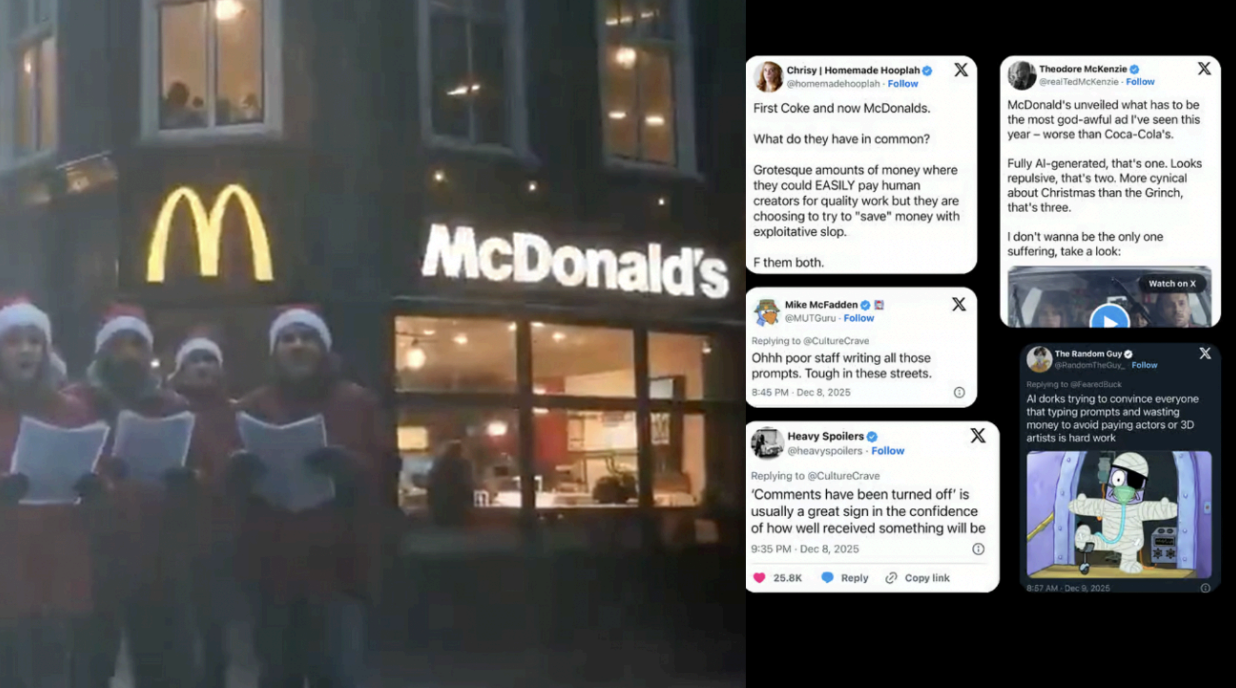
People weren’t just critiquing the aesthetics — they were offended. Top comments called it “repulsive,” “cynical,” and “exploitative slop.” One viral response labeled it the most god-awful ad of the year. The backlash was so intense that McDonald’s disabled comments to stop the bleeding, then quietly pulled the spot altogether.
What stood out wasn’t the criticism itself. Brands get roasted all the time. What stood out was how people reacted — and what they didn’t care about.
Nobody asked what model was used. Nobody wanted to hear about the sophistication of the pipeline or the experimentation behind the scenes. When McDonald’s tried to shift the conversation toward the process — explaining the tools, the effort, the craft — the reaction didn’t soften. It went the other way.
What the Audience Was Really Reacting To
Why such a visceral public response?
I don’t believe the audience was reacting to the technology at all. We were reacting to what it signaled.
It felt like a brand known for cultural presence and human storytelling had traded those things in — replaced them with something efficient, synthetic, and hollow. The backlash wasn’t about AI. It was about the sense that human creativity and authenticity had been sidelined.
That’s the signal many organizations are missing.
It’s tempting to dismiss moments like this as just another tech backlash. We’ve seen resistance before — with the internet, social media, CGI. But this feels different because the function of the technology is different.
The internet connected us. Social media amplified us. Generative AI attempts to replicate us.
For the first time, technology isn’t just transporting human expression — it’s synthesizing it. Writing, voices, faces, styles — all generated without the struggle that usually gives them meaning. People aren’t rejecting this content because they’ve weighed the ethics. They’re rejecting it because it feels off. Hollow. Uncanny.
This is the disconnect coming into focus.
I call it the AI Authenticity Gap.
It’s the growing distance between what organizations believe AI adds to creative work and how audiences actually experience the result. And when brands try to close that gap by explaining the technology, they usually aren’t fixing the problem. They’re making it worse.
The Reset
Here’s why explanation backfires.
We’re crossing a line — from tool to agent.
A tool still feels like human intent using leverage. We never thought a computer directed a movie or painted a masterpiece. We knew the human was still there, wrestling with choices, obsessing over details, struggling toward something meaningful. The technology extended human vision; it didn’t replace it.
Generative AI feels different. When a system makes thousands of micro-decisions on your behalf — about tone, structure, lighting, cadence — the human shifts from architect to client. The struggle gets outsourced. And audiences feel that immediately.
They don’t want to be replaced. They don’t want to be minimized. And they don’t want to be told that efficiency should be enough.
That’s the reset we’re living through right now:
• AI doesn’t get credit for novelty — it gets credit for whether it preserves human creativity
• AI doesn’t get credit for effort — it gets credit for how authentically the work feels
• And when the experience feels hollow, explaining the technology only confirms the loss
This doesn’t mean “don’t use AI.” It means the bar has moved.
In a world of infinite, cheap generation, human intent becomes the scarce asset. Invisible improvements win. Surface-level automation gets punished.
Final Point
The AI Authenticity Gap is widening — not because the technology is advancing too fast, but because human meaning is being priced too cheaply.
In a world where generation is effortless and infinite, creativity stops being about output and starts being about intent. What audiences are responding to isn’t whether AI was used, but whether anything human was still at stake in the work. Struggle. Judgment. Taste. Authorship.
That’s the recalibration happening now.
The honeymoon is over.
AI will earn its place in creative work only when it makes the outcome feel more human, not less. Invisible improvements will be rewarded. Surface-level automation will be punished. And work that looks like it cost nothing to make will be worth exactly that much to the people experiencing it.
The question is no longer whether AI belongs in creative work.
It’s whether it earns its place there.


