

The AI market just hit its reset button.
After two years of headlines, roadmaps, cultural manifestos, and hype-driven product launches, the software world finds itself in a quieter moment — one where investors, operators, and customers have stopped clapping for AI theater and started demanding something much harder:
Proof.
Proof that AI creates revenue, lowers cost and improves margins, accelerates workflows, and tightens moats.
The “just say you’re doing AI” era is officially over. We’ve entered the era of AI economics — where companies are valued not for what they say, but for what they can measure.

Ben Murray’s review of 130+ public-company earnings calls reveals a three-stage maturity curve that has become the de facto AI valuation model:
The lesson is direct: AI only matters when it becomes economically legible — and economically defensible.
And that legibility only happens in one place: inside the workflow.
AI’s value doesn’t exist in isolation — it exists in workflows.
For years, companies treated AI like a brand asset: a slide in a pitch deck, a press release bullet, a cultural inspiration.
But when you strip away the theater, the stubborn truth emerges:
AI has no economic value unless it is embedded inside a workflow.
Not adjacent to it.
Not representative of it.
Inside it.
AI becomes economically meaningful only when it improves a visible unit of commercial work. For example:
Across every major AI monetization model — seat uplift, usage metering, ROI expansion, new category creation, workflow lock-in, margin improvement — the shared foundation is the same:
The workflow is the economic unit. AI is the accelerator.
In our work at Traction AI supporting GTM teams, one pattern has become impossible to ignore: AI only creates business advantage when the underlying workflow is sound.
Applied to a broken or chaotic process, AI doesn’t solve the problem — it amplifies it.
We’ve seen this repeatedly across the companies we support at Traction AI. Tools alone rarely move the needle.
The real gains appear only after the workflows have been mapped, instrumented, and operationalized. Once that foundation is in place, AI compounds value instead of creating noise.
Boards and investors have shifted from “Do you have AI?” to a much sharper set of questions:
These aren’t marketing questions. They are operator questions.
And the companies answering them well are the ones building real AI economics, not AI performance art.
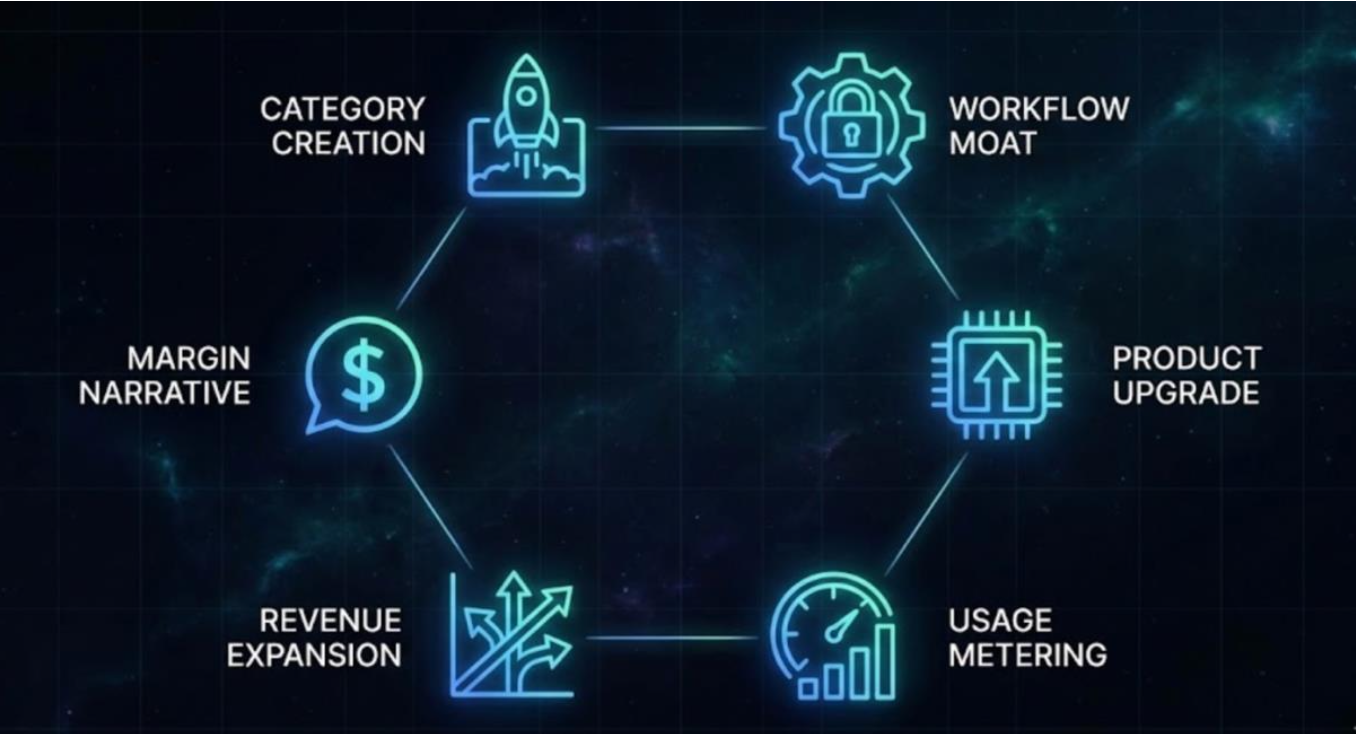
Across the public markets, the companies rewarded most consistently demonstrate one or more of the following monetization patterns:
Different tactics, same foundation: all six models require AI to be attached to a repeatable, measurable workflow where value can be observed and priced.
Without workflow clarity, none of them are achievable.
Leading companies are now expected to publish a recurring cadence around five core pillars:
This isn’t a communications exercise. AI is now about operational discipline.
The AI reset shouldn’t be discouraging. It should be clarifying.
We’ve returned to an environment that rewards:
The market is rewarding the people who build systems, not the people who write slogans.
The companies that win the next decade of AI won’t be the ones shouting the loudest. They’ll be the ones who understand where the work happens — and design their systems and AI strategy accordingly.
Because in this new era:
AI doesn’t create value. AI inside the workflow does.
This is your Traction AI advantage.


