
Most are not achieving AI operating leverage. And it's not because they haven't tried.
FTI Consulting surveyed two hundred senior PE fund and operating leaders in December 2025 and found that only seven percent—seven—have gotten AI to true enterprise-wide production inside a portfolio company. Another twenty-nine percent have it running, but walled off inside a single function or use case. The other sixty-four percent are still piloting, experimenting, or not using it at all.
That gap between adoption and leverage isn't unique to private equity. 85% of AI use cases across the broader economy don't generate meaningful business value, and only 2% qualify as advanced enough to change how work actually gets done. But for PE, that gap is especially expensive. McKinsey studied 471 PE-backed companies and found the ones that actually embed AI into how they operate carry a median revenue multiple roughly 130 percent higher than the ones still using it opportunistically. The market has already priced that gap into every exit.
The problem isn't that PE funds haven't bought into AI. The problem is they're buying into it wrong.
Most are treating AI as a tool. They need to treat it as an operating system.
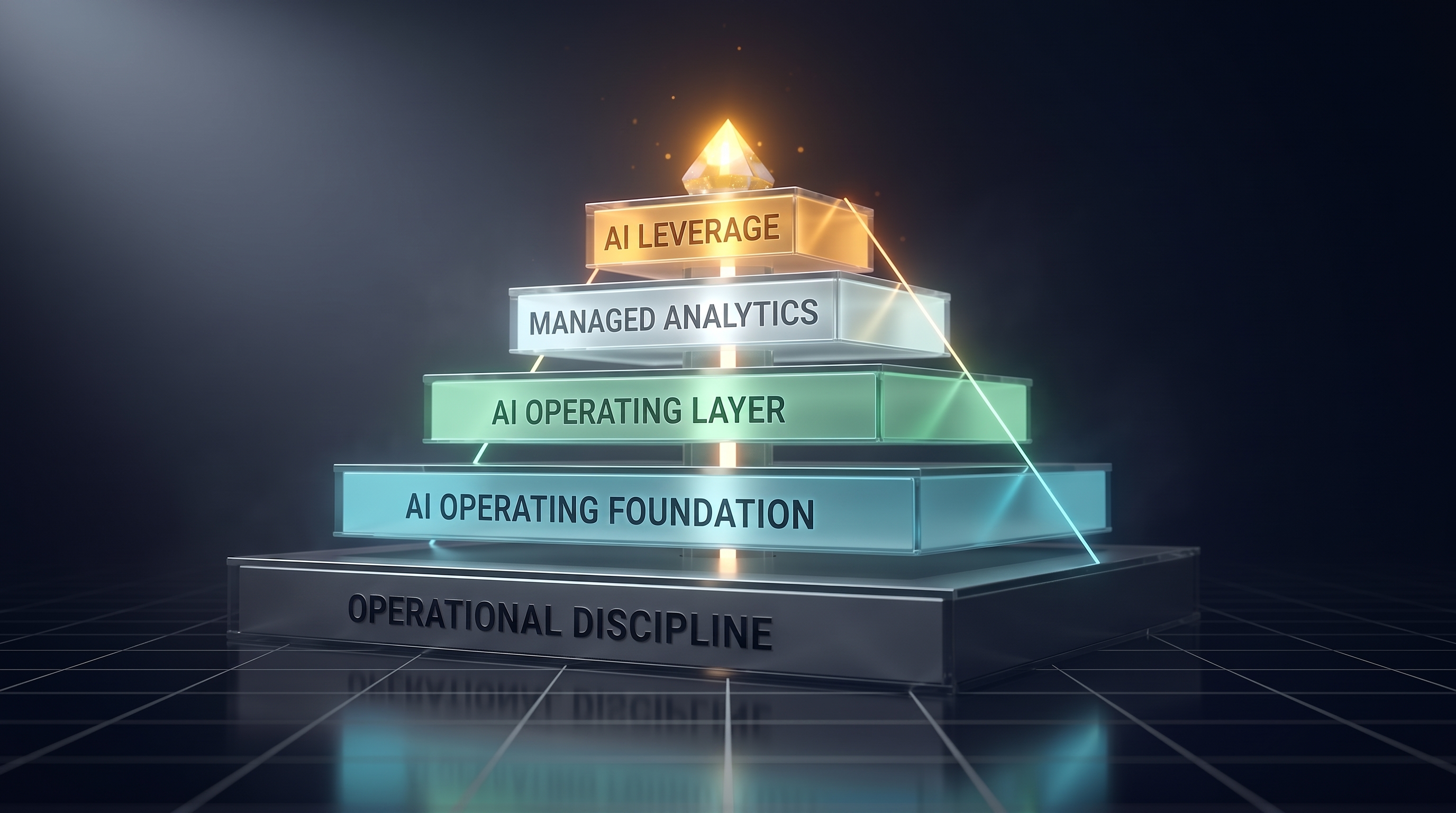
AI operating leverage lives at the intersection of three things—and only shows up when all three work together.
1. Operating Foundation (Context Vault)The single source of truth for how your GTM actually works. This isn't a slide deck — it's five layers of documented, maintained context: who you are and what you sell (Identity), where you're going and how you'll win (Direction), what you actually know versus what's assumption (Evidence), what's in motion right now (Active Work), and what's already been decided and by whom (Decisions & Authority). It's the context that keeps AI from hallucinating.
2. Operating Layer (AI-Powered Workflows)The skills that sit on top of the Foundation and do the actual work: scoring leads, routing deals, drafting outreach, analyzing customer health, forecasting risk. These only work if they're reading fresh Foundation data. A skill running on stale context produces stale outputs.
3. Managed Analytics (Health & Drift Detection)The monthly audits that catch Foundation drift before it breaks your workflows. Without these audits, your Foundation quietly goes stale. Your skills start reading outdated qualification criteria, competitor info, or deal patterns—and start making recommendations that feel random. Monthly health audits catch that within weeks, before it shows up as a stalled deal or a miss.
Only when all three are working together do you get AI operating leverage. Without the Foundation, your Layer produces garbage. Without the Layer, your Foundation is just a document. Without the Analytics, both drift silently until deals close at lower rates and nobody sees it until the quarterly board deck goes out.
Here's what "the Layer produces garbage" actually looks like in practice.
A CRO at a mid-market portfolio company starts asking her AI tools direct questions about her business — what's slowing deals down, whether this quarter's forecast is realistic. The answers come back confident and completely wrong. Not wrong in an obviously-broken way — wrong in a way that sounds plausible until she checks it against what she actually knows about her own pipeline. The forecast numbers don't reconcile with reality. The advice on why deals are slowing down is generic best-practice language, not anything about her actual deal patterns.
The tool isn't broken. It's ungrounded. It has no verified record of her ICP, her qualification criteria, her win/loss patterns, or what's actually sitting in her pipeline right now — so it fills the gap with something that sounds like an answer. That's not a model problem. That's a governance problem: nothing was checking whether the AI had the context it needed before it opened its mouth.
This is what happens to every portfolio company that treats AI as a tool instead of an operating system — and it's the reason "guardrails" can't be an afterthought bolted onto AI use cases after the fact. The guardrail has to be upstream, in the Foundation itself.
Here's where the disconnect happens.
Every portfolio company in a fund is, right now, independently building and rebuilding the same operating foundation — the same qualification criteria, the same lifecycle-stage definitions, the same playbook logic — usually carried by a single RevOps generalist who owns it in their head and in one company's CRM instance. None of that work compounds across the portfolio. All of it walks out the door the day that hire leaves. The next operating partner starts the clock over at zero.
Meanwhile, the IC memo for the next acquisition promises the same revenue synergies as the deal before it. It promises the playbook will travel. It promises the operating model will scale.
Then the deal closes, and that memo goes in a drawer. The new operating partner walks into a CRM that looks nothing like the portfolio company before it, inherits none of the logic that made those synergies real anywhere else, and starts diagnosing from zero — as if the fund had never bought a company before this one. The qualification criteria that took the last portfolio company four months to get right never left that company's HubSpot instance. The lifecycle-stage logic lives in that instance alone. The winning playbook sits in a diligence slide deck that nobody reopens.
That's not portfolio support. That's a parallel set of independent pilots — each portfolio company an AI User solving the same problem by hand, with no shared guardrails and no way to catch it when one of them drifts. Each one a missed synergy. Each one a drag on valuation at exit.
A stale or ungoverned Foundation doesn't fail quietly in just one way — it fails in at least five, and they compound:
Every one of these traces back to the same root cause: Foundation drift. And every one of them has the same fix — not a policy document, but a mechanism. Concretely, that means an AI skill checks its own dependencies before it runs: if the qualification criteria, positioning, or pipeline data it needs hasn't been verified as current, the skill simply doesn't fire. Not a bad guess — no output at all, with a flag that says what needs to be verified first. That's what turns "guardrails" from a slide into something an operating partner can actually rely on.
The solution isn't to hire better operating partners. It's to stop making every operating partner reinvent the wheel — and to build the checking-your-own-work mechanism in from the start.
A portfolio-wide Context Vault — the qualification criteria, the lifecycle definitions, the ICP, the playbook that already worked — captured once and inherited by every company that joins the portfolio after it, is what turns AI Users into AI Operators.
Once that Foundation exists, it stops being a reference document. It starts running.
An AI agent checks every portfolio company's deal-stage data against the fund's own qualification criteria before the quarterly board deck goes out, not after a stalled deal shows up in it. It flags the portfolio company whose "Sales Qualified" stage has quietly drifted from what the fund actually means by that phrase — the drift LPs never see until it costs them money.
Another skill routes warm leads to the right person inside each portfolio company using fund-wide ICP and playbook logic, not local guesses. A third analyzes every portfolio company's customer health against the same health criteria, in real time. None of these skills will run against context that hasn't been verified as current — that's the guardrail, not a footnote to it.
And every month, an Embedded Operations Partner audits all three layers across the portfolio — Foundation drift, Layer performance, whether the skills are generating the outcomes you expected.
The next acquisition doesn't start from a blank portal. It starts from a portfolio already running the same system. It inherits the Foundation, the workflows, the analytics. Its first ninety days become inheritance instead of invention.
None of this requires a $250K-a-year principal sitting on every portfolio company. It requires an Embedded Operations Partner working from a Foundation that already holds the diagnosis and the playbook — running at the cost of a strong analyst, not a principal. This is the architecture that actually compounds.
Every fund is choosing one of two paths. Most don't realize they're making a choice.
Path 1: Portfolio-Wide AI Operating System
Path 2: Independent AI Pilots
McKinsey's data is blunt: the market refuses to reward Path 2. Companies that actually embed AI operating leverage into how they work—all three components working together—exit at 130 percent higher revenue multiples than the ones that don't.
Ask your operating partner which path they're running right now. Most cannot answer, because nobody has ever made them look.
The reason PE funds are missing this isn't that they don't understand AI. It's that they're not structuring AI like an operating system.
An operating system doesn't live in one function. It doesn't run one use case. It lives in the workflows where work actually gets done—your sales motion, your marketing motion, your customer success motion—and it depends on three things working together in concert:
Leave any one of them out, and you've got an experiment, not an operating system. You've got an AI User, not an AI Operator.
The funds that get this right—the ones that build all three, wire them together, maintain them monthly—are the ones that turn AI from a cost center into a competitive advantage. They're the ones that actually hit the synergies their IC memos promised. They're the ones that exit at 130 percent higher multiples.
The others? They're funding the same AI User pilot at every portfolio company, calling it operational support, and leaving that premium on the table.
Your move.


