
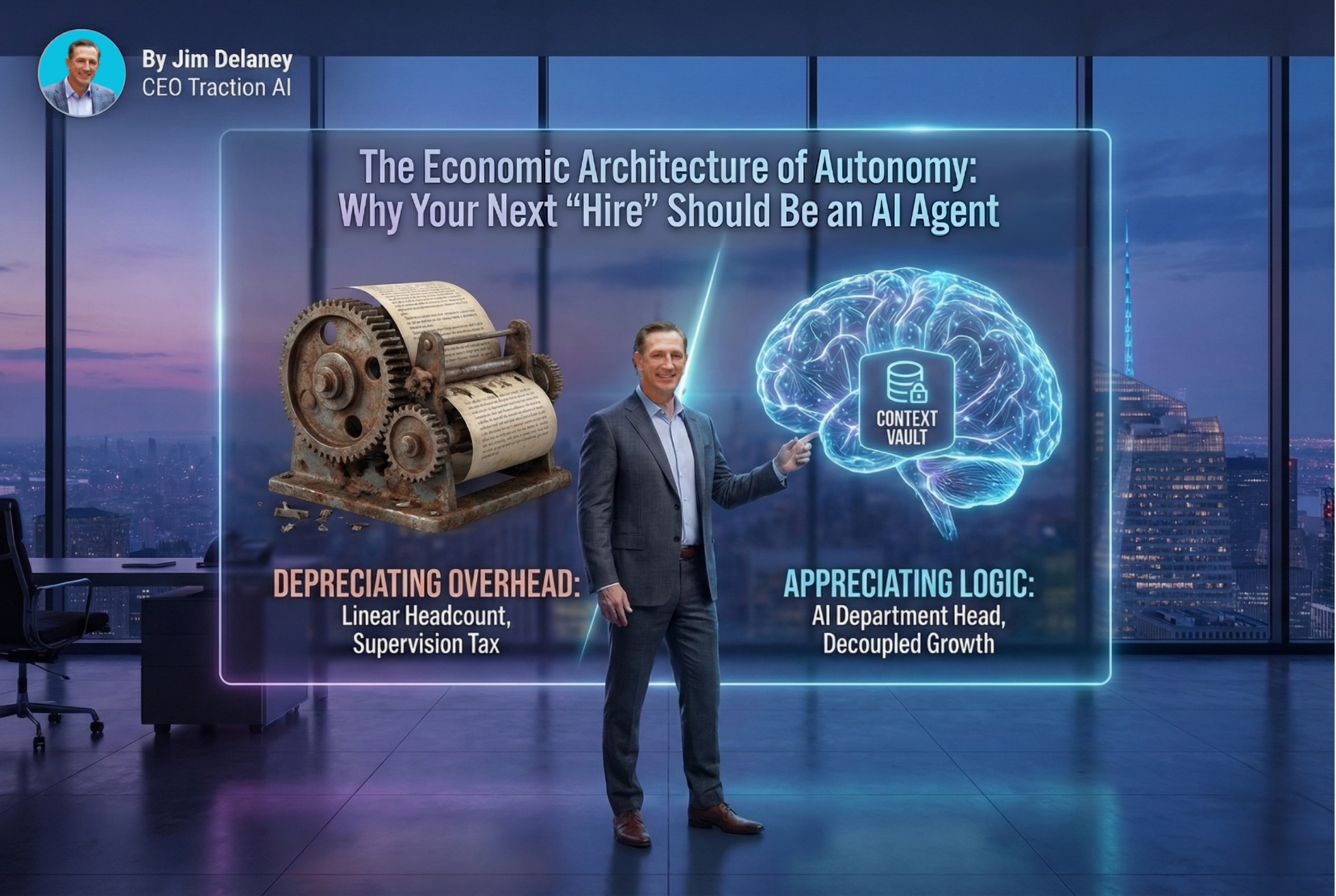
In my previous writing, I’ve been blunt about the Intelligence Poverty Line — that invisible threshold where a company either learns to trade silicon for labor or gets disrupted out of existence. But as Maddie and I have been dissecting the current market reset, it’s become clear that the "Co-pilot" era has actually created a new kind of financial drag.
We are seeing a "Hype Hangover" because leaders expected AI to magically fix their margins. Instead, they’ve added expensive seat licenses for "assistants" while their headcount remains stubbornly tied to their revenue growth. Most CEOs are still "judging the future through a keyhole," looking at AI through their own limited, traditional business experiences rather than seeing the tectonic shift occurring in reasoning capabilities.
The problem is economic, not technical. To move the needle on the P&L, you have tomove from Task-Based Efficiency to Outcome-Based Autonomy. You have to stop treating AI as a "productivity hack" and start treating it as a Structural Advantage in your unit economics.
The Economic Argument: Depreciating Overhead vs. Appreciating Logic
In the old world—the one most CEOs are still judging through a keyhole—labor is a depreciating overhead cost. You hire an SDR, you train them, and they produce a linear amount of output. To double your leads, you (roughly) double your SDR headcount. Your margins stay flat because your costs scale alongside your success.
When you transition an AI from a "Co-pilot" to a "Department Head," you are creating an Appreciating Software Asset.
1. The Death of the "Supervision Tax"
When an AI acts as a co-pilot, it requires a human "babysitter." If an agent drafts a response but a manager spends ten minutes reviewing it, you haven’t saved money; you’ve just shifted the labor from "doing" to "supervising". This is the Supervision Trap—a state where a leader is operationally responsible for the AI's actions but physically unable to monitor them all.
The Board-Level Reality: The "Supervision Trap" isn't just an efficiency killer; it's a liability. As AI handles thousands of micro-decisions per hour, the human ability to monitor every action disappears. "I didn't know the AI did that" is no longer a defense in a 2026 boardroom. If you are still trying to be "In-the-Loop," you aren't a leader; you are a bottleneck in your own scaling engine.
By granting an agent autonomy to own an outcome, you eliminate the Supervision Tax. You move to Algorithmic Accountability, where you build systems that audit other systems. This is how you finally decouple headcount from revenue growth.
2. Reasoning Density as Infrastructure
Most CEOs judge AI by "how fast it writes". This is a mistake. The real value is Reasoning Density—the threshold of reasoning a company must hit to move beyond simple tasks to systemic logic where the AI makes micro-decisions about resource allocation.
When your AI is integrated into your Context Vault—a reasoning system where GPT-5.4 synthesizes massive datasets, Fathom connects transcript signals, and HubSpot integrates system records—it begins to reason on behalf of the GTM team. It ensures the AI has the same "memory" of a client relationship as a 10-year veteran employee. It isn't just "generating text"; it is managing the logistics and supply lines of your revenue engine.
GTM Case Study: The Autonomous "Revenue Recovery" Department
To see what this looks like in practice, let’s move past the theory. Imagine you are a CEO facing a 4% churn rate. In a "Co-pilot" world, you give your CS team an AI tool to help them write better "save" emails. Your headcount stays the same, and your churn might drop to 3.8%. That is a "hack," not a transformation.
In a Department Head world, you appoint an Autonomous Revenue Recovery Agent.
The P&L Result: You have effectively hired a "Department Head of Churn" that works 24/7, possesses Unified Institutional Memory, and costs less than a single junior SDR. This isn't "doing things faster"; it's changing the math of the business.
Managing the "Glass Box": Trust as a Financial Asset
The bottleneck to this economic nirvana isn't technical capacity—it's the Trust Gap.Leaders are hesitant to give AI "the keys to the kingdom" because the cost of a mistake feels too high.
But as a multi-time CEO, I can tell you: Trust is a financial asset. The faster you can trust your agents, the faster you can scale without hiring. We solve this through the "Glass Box" approach:
The Survival Warning: If you stay in the "Co-pilot" phase because you are afraid to delegate, you will be "disrupted out of existence" by a leaner competitor who is already operating Above the Line
Conclusion: The CEO’s New Board Mandate
The era of "AI experimentation" is dead. Boards are no longer impressed by "AI innovation labs" that don't produce bottom-line savings. They want to see Integration Depth.
If your AI doesn't know your specific HubSpot triggers or your Fathom signals, it’s not a workflow tool—it’s just a toy.
The transition from "Co-pilot" to "Department Head" is the most significant leadership pivot of this decade. It requires you to stop being a supervisor of tasks and start being a Curator of Logic.
The question for your leadership team is simple: Are you still paying the "Human Tax" on every decision, or are you ready to build a system that learns and earns while you sleep?
The Intelligence Poverty Line is moving. Make sure you’re on the right side of it.


