
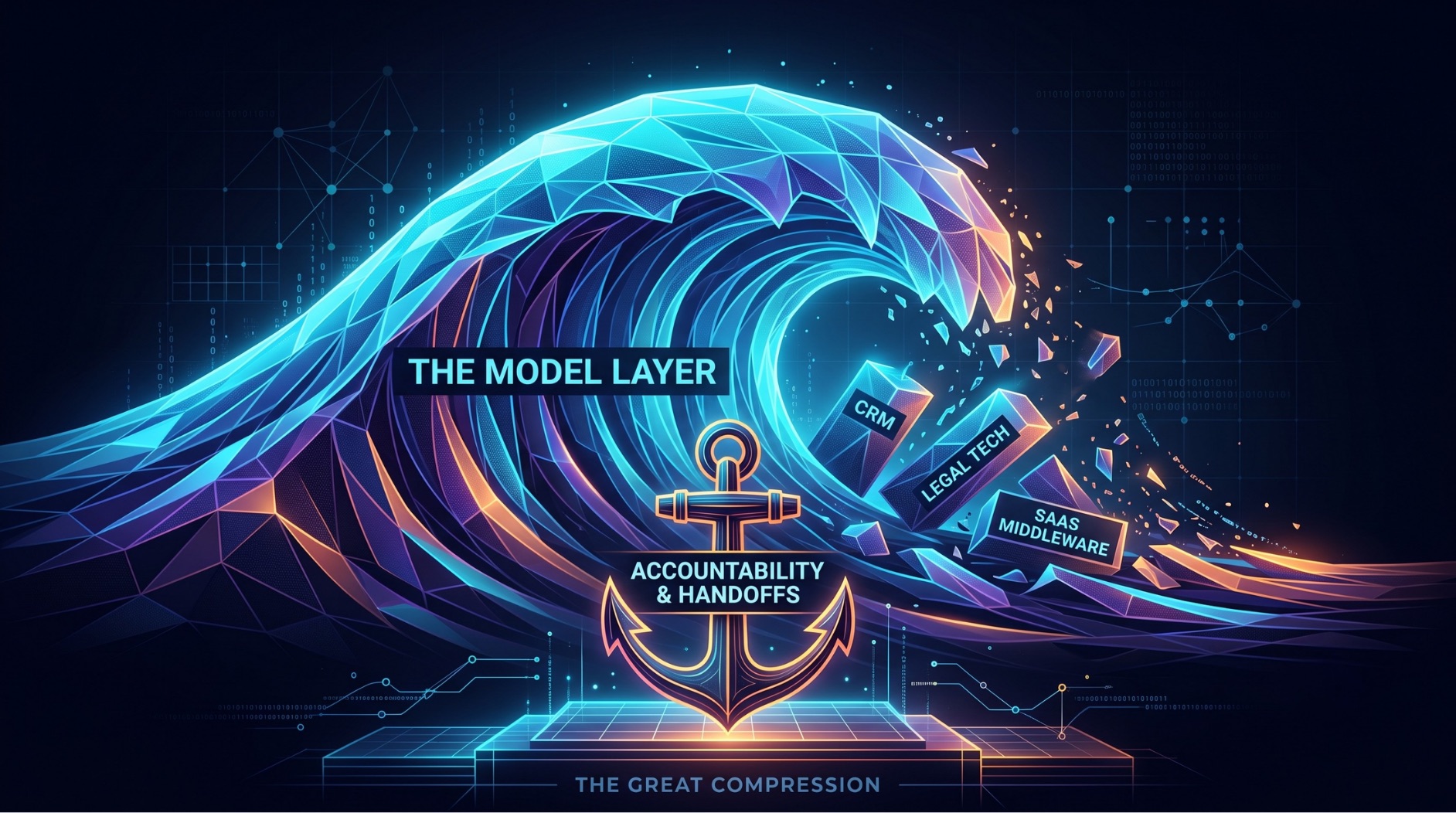
Alex Karp, the eccentric CEO of the multi-billion-dollar data analytics giant Palantir Technologies, went on CNBC looking like a madman because he’s finally saying out loud what every B2B founder is quietly panicking about. A few days later, Microsoft’s Satya Nadella dropped a massive essay on the "Reverse Information Paradox"—which is just a polite, corporate way of saying: You’re paying the AI labs to take your job. You pay them once with your subscription cash, and a second time with the workflows, prompts, and corrections you feed them to train their models.
If you look past the theatrical corporate dread, the threat isn’t just that these labs are absorbing your data. It’s that they’re moving up the food chain. When Anthropic drops Claude Code, Claude Legal, and Claude Security, they aren’t just selling the engine anymore. They’re building the whole car.
If you’re building a tech startup today, the question isn’t "How do we integrate AI?" It’s: "How do we survive when the model layer decides to swallow our entire category?"
Here is how you actually hold your ground, based on the operators who are navigating it right now.
1. Sell the "Unwritten Rules" (Where the Bodies Are Buried)
A frontier model knows everything that’s ever been written down on the public internet. What it doesn't know are the unwritten rules, the political nuances, the weird industry workarounds, and the hyper-specific human relationships that actually make a business run.
Thirty years in a legacy industry teaches you things that will never exist in a public training dataset.
2. Own the Heart Attacks, Not Just the Homework
A lot of founders think their beautiful UI or custom workflow is their moat. It’s not. If a workflow is highly visible and logical, a frontier model can observe it, mimic it, and reimplement it in a few prompts. What the AI labs cannot mimic is accountability. OpenAI and Anthropic want to sell trillions of tokens; they do not want to stand in front of a strict financial regulator, absorb legal liability for a bad contract, or handle a compliance audit.
Own the assurance, not the intelligence. The lab ships capability. It doesn’t ship the evidence trail, the risk committee, or the liability.
3. Own the Handoffs, Not the Tasks
Most software acts as a "node"—a single place where a human sits down to execute an isolated task, like updating a CRM or filing an invoice. AI makes automating those isolated tasks trivial.
The real value in an enterprise isn't the single task; it’s the friction of handing off work between entirely different departments, external vendors, and legacy systems.
The Reality Check
We’ve all heard that if switching models is as easy as an API swap, your tech stack is flexible. But remember the flip side: if switching models is easy for you, switching vendors is just as easy for your customer.
You will never out-model the multi-billion-dollar labs. The winners of this era won't be the ones using the absolute newest, flashiest model. They’ll be the ones who use the tech to lock down their customer relationships and distribution loops so deeply that if the underlying model vanished tomorrow, the customer would still desperately need them.
Karp sells the fear because it moves his stock. But as a founder, you just need to understand your architecture clearly enough to know what’s actually worth defending.
The Reality Check
We’ve all heard that if switching models is as easy as an API swap, your tech stack is flexible. But remember the flip side: if switching models is easy for you, switching vendors is just as easy for your customer.
You will never out-model the multi-billion-dollar labs. The winners of this era won't be the ones using the absolute newest, flashiest model. They’ll be the ones who use the tech to lock down their customer relationships and distribution loops so deeply that if the underlying model vanished tomorrow, the customer would still desperately need them.
Karp sells the fear because it moves his stock. But as a founder, you just need to understand your architecture clearly enough to know what’s actually worth defending.


