
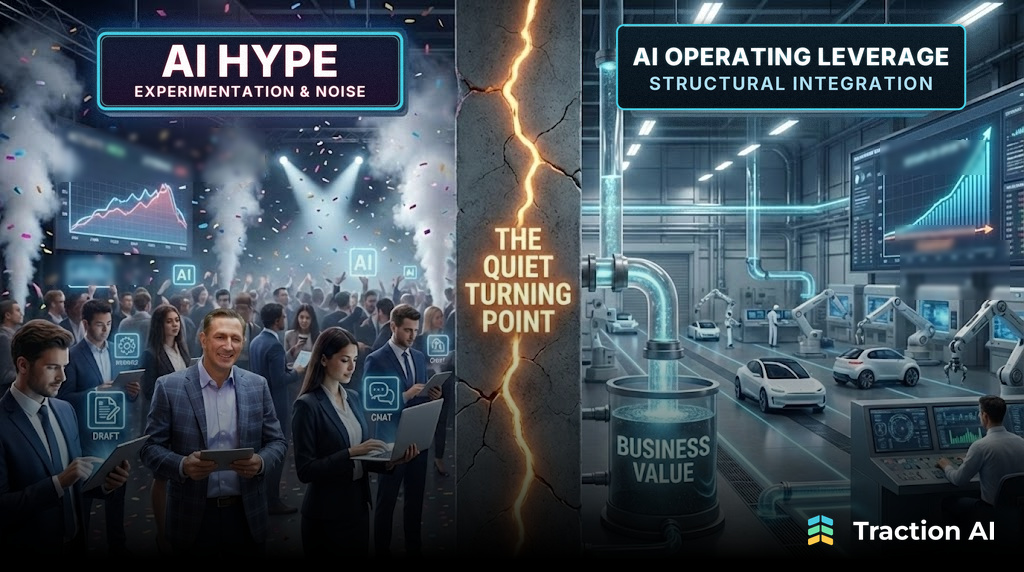
We just spent billions on a better spellcheck. Now comes the bill.
Walk into any office today—or just scroll through your team’s Slack—and you’ll see the same thing. People are "using" AI. They’re prompting ChatGPT to write updates. They’re using Copilot to summarize threads. The adoption charts look great. The usage metrics are up and to the right.
But look closer. Are projects moving faster? Is the headcount growing slower?
Is the business actually different?
No.
We have entered the "Trough of Disillusionment," but I prefer to call it the Efficiency Illusion. We have successfully made our busy work more efficient, but we haven't touched the actual work.
Here is the uncomfortable truth: AI adoption is at an all-time high. AI leverage is near zero.
The "Digital Caffeine" Crash
We are living through the corporate equivalent of a sugar crash.
While more than half of knowledge workers (55%) are now using AI every week, the actual business impact is shockingly low. We aren't seeing transformation; we are seeing digital caffeine. We are jittery, we are moving fast, but we aren't going anywhere new.
According to the recent 2026 AI Proficiency Research Report, the gap between activity and value is now undeniable:
In PE terms, this means AI is being treated as an employee convenience layer — not an operating leverage strategy.
The Jevons Paradox of 2026
Why is this happening? Because we fell into the Jevons Paradox. In economics, this paradox states that as technology increases the efficiency with which a resource is used, the total consumption of that resource increases rather than decreases.
When you give an employee a tool to write emails faster, you don’t get "saved time." You usually just get more emails. You get faster meetings. You get longer documents that nobody reads.
Helpful? Sure. But let’s not confuse helpful with leveraged.
Operating leverage happens when the system starts doing work that used to require people. And according to the data, only 2% of reported use cases were judged to be "advanced"—meaning they used automations to benefit the organization rather than just contributing to individual productivity.
2%. That is the reality of the "AI Revolution" inside most companies right now.
The Leadership Delusion
If the reality on the ground is so bleak, why are leadership teams still acting like the transformation is working?
Because they are living in a different reality. The C-suite is 31% more likely than individual contributors to believe they have achieved widespread AI adoption.
This isn't just optimism; it's resource bias. Leadership is confusing their own privileged access with the company's reality.
Executives sit in boardrooms seeing the pilots, the strategy decks, and the "formal AI strategy" (which 66% of them believe exists, versus only 20% of employees). They assume the organization is moving at their speed.
But down on the ground, the "system" behaves exactly like it did before. The troops aren't building the future; they're just Googling things faster.
The Authenticity Gap Meets The Efficiency Gap
This disconnect connects directly to something I’ve been writing about on the creative side — what I call the AI Authenticity Gap.
I’ve noticed a reaction in myself that I can’t unsee. The moment I realize a video or image was made with AI, I stop experiencing it and start examining it. It’s like obsessing over a magician’s sleight of hand instead of enjoying the trick. Once you spot the mechanism, the spell is broken.
We saw this with the McDonald's holiday ad backlash. Audiences didn't recoil because of the tech; they recoiled because the brand had shifted from being an architect of culture to a client ordering from a black box . They outsourced the struggle.
Something similar is happening inside companies, but operationally.
AI is mostly being used to make people more efficient at "busy work," not to make systems more intelligent. So work still looks busy. Humans still carry the same cognitive load. Processes still depend on handoffs, memory, and manual judgment.
Just as consumers reject "slop" content, employees reject "slop" processes—AI implementations that add steps without removing the burden.
The novelty dividend is gone. Nobody gets credit anymore just for "doing AI." Having policies (+17% YoY) and tool access (+16% YoY) is just table stakes.
The new bar is simple, almost brutally so: Where did the work go?
The Cure: From Assistant to Agentic Workflows
The companies that will cure this hangover are the ones that stop asking, "How do we use AI in this task?" and start asking, "Why does this human step exist at all?"
This requires a move from "Chatbot" to "Agentic Workflows."
That’s the mental shift. AI stops being a smarter intern (Tool) and starts becoming part of the operating layer itself (Agent).
You see real leverage when:
But here is the catch: You can't have Agentic Workflows without clean data. You can put a chatbot on top of messy folders and it will hallucinate a decent answer. But you cannot build an autonomous agent on top of messy data. This is why the next phase is the "Data Reality Check." The barrier to leverage isn't the model; it's the plumbing.
The Great Divide
We are moving into a divide between AI Users and AI Operators.
AI Users are more productive, but still fundamentally linear. They type prompts into black boxes. AI Operators are where systems do the work, and growth starts to decouple from labor.
Most organizations still sit in the first group. They feel like they’re "in AI," but their cost structure and throughput still look like 2022.
In the creative world, AI will only earn its place when it makes the outcome feel more human, not less. In the operational world, AI will only earn its place when it makes the system more autonomous, not just the worker more assisted.
That’s the reset. The hype cycle rewarded experimentation. This cycle rewards structural change.
And the companies that cross that line first won’t just be more efficient. They’ll be operating on a different curve entirely.


